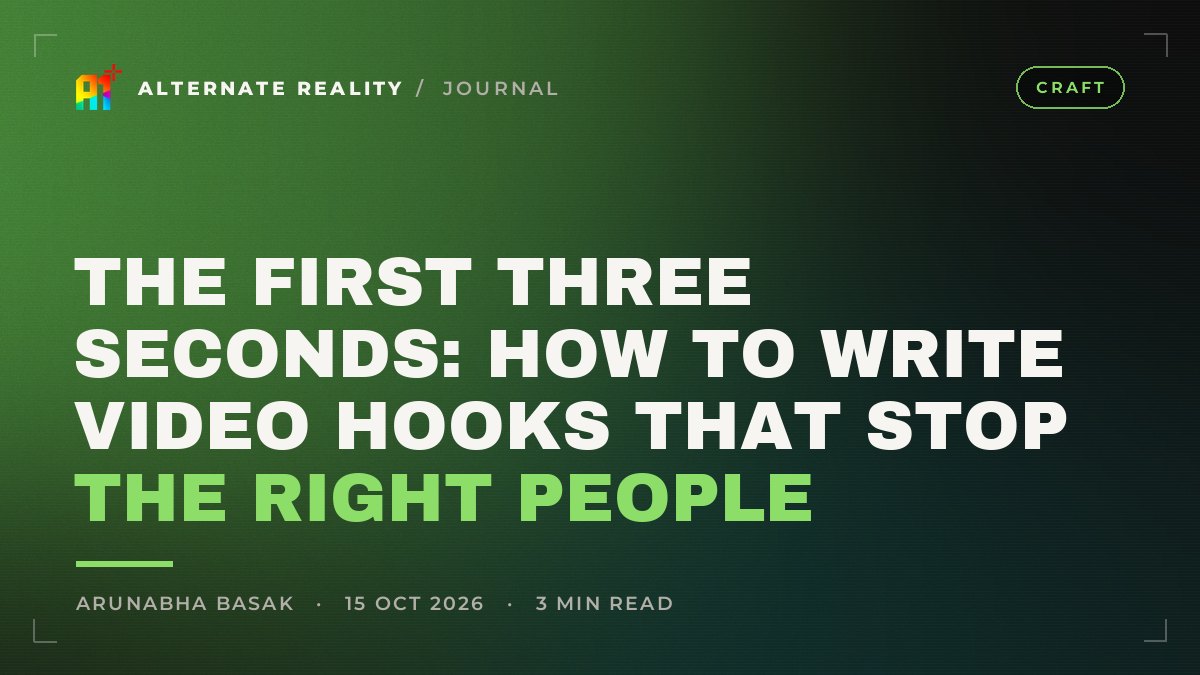
The first three seconds: how to write video hooks that stop the right people
Instagram now measures how many viewers skip your Reel in the first three seconds. Here is how we write and film hooks for founders and speakers, including the visual hook most people forget.

You can have the best insight in your industry, and it won't matter if nobody hears the second sentence.
That's not a metaphor any more. Instagram's Reels insights now show a skip rate — the share of views where people scrolled away within the first three seconds. It replaced the older view rate, which counted people who watched past three seconds. Either way, the platforms are telling you exactly where the battle is fought.
Is there a "good" three-second retention rate?
Honestly, there's no official number. Instagram and TikTok show you the graph but don't publish a benchmark. Across creator communities, around 70% still watching at three seconds is treated as a healthy rule of thumb, but you'll find blogs claiming anything from 32% to 85%.
The better benchmark is you. Look at your last 20 videos, find your average, and try to beat it. A niche B2B audience and a comedy account will never share a target.
The hook has two halves: what they see and what they hear
Most advice about hooks is about words. But most people meet your video on mute. So your hook works on two channels at once.
The visual hook (frame one):
- Movement in the first frame. Walk in, turn to camera, put something down. A static talking head reads as an advert.
- A face, close enough to read. Eyes on the lens.
- On-screen text of seven words or fewer that makes sense without sound.
- Start mid-action. Cut the breath, the smile and the "so".
The spoken hook (first line):
- One breath. If you need a second breath, it's two sentences, and you've lost them.
- About them, not you. "How I got a million views" is about you. "How you get your first hundred thousand, using what got us a million" is about them.
- Specific beats clever. "Coaches" is a crowd. "Coaches charging £3,000 who still do free discovery calls" is a person, and people stop for themselves.
Five hook patterns we use for founders and speakers
- The call-out. "If you're a speaker with a great talk and no clips of it, this is for you."
- The costly mistake. "Stop opening your keynote with your CV. Here's what it costs you."
- The flip. "Posting every day is why your account stalled."
- The receipt. Lead with a real, specific result, then show how it happened.
- The cold open. Start in the middle of a scene: "I'm backstage and the clicker has just died."
Notice that none of these are clickbait. Each one makes a promise the video keeps. A hook that over-promises gets the three seconds and loses the trust.
How we test hooks on a shoot day
On every shoot, we film three versions of each hook. It takes seconds on the day and gives us weeks of tests afterwards. Post the strongest first. If a video underperforms, re-cut it with a different opening and post it again later. The middle of the video was rarely the problem.
A quick checklist before you post
- Does the first frame have movement and a face?
- Does the on-screen text work with the sound off, in seven words or fewer?
- Is the first line one breath, and about the viewer?
- Is there a specific number, name, place or cost in it?
- Does the rest of the video actually deliver what the hook promised?
Get the first three seconds right and you earn the chance to be heard. Everything you know only matters after that.
Frequently asked questions
What is a good three-second retention rate?
Platforms don't publish an official benchmark. Many creators treat roughly 70% still watching at three seconds as healthy, but niche and format vary so much that your own historical average is the most useful comparison.
What is Instagram skip rate?
Skip rate is a Reels metric showing the percentage of views where people scrolled away within the first three seconds. A lower skip rate means your opening is doing its job.
How long should a hook be?
Aim for one breath — usually under about 14 spoken words — supported by on-screen text of seven words or fewer, so it works with the sound off.
Should every video start with a question?
No. Questions are one tool. Specific statements, a surprising number, a call-out of the exact viewer or starting mid-scene often work better, especially for authority content.